

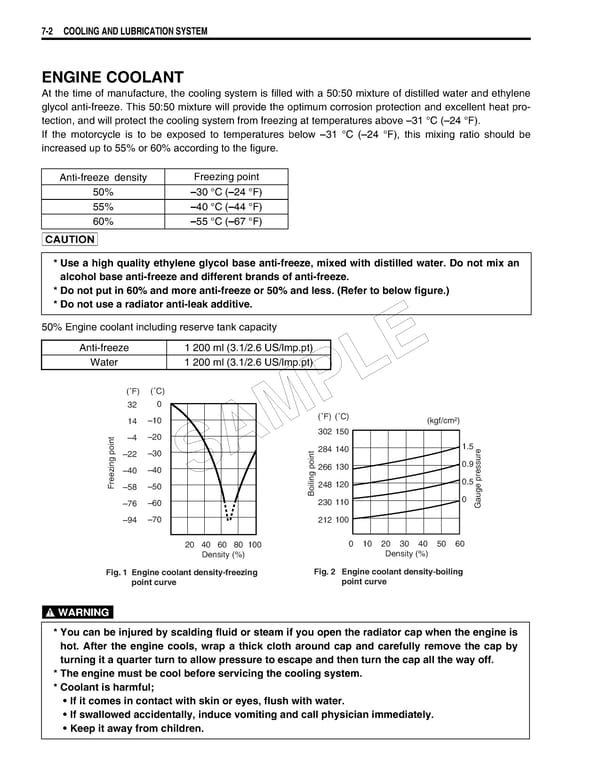
7-2 COOLING AND LUBRICATION SYSTEM ENGINE COOLANT At the time of manufacture, the cooling system is filled with a 50:50 mixture of distilled water and ethylene glycol anti-freeze. This 50:50 mixture will provide the optimum corrosion protection and excellent heat pro- tection, and will protect the cooling system from freezing at temperatures above –31 °C (–24 °F). If the motorcycle is to be exposed to temperatures below –31 °C (–24 °F), this mixing ratio should be increased up to 55% or 60% according to the figure. Anti-freeze density Freezing point 50% –30 °C (–24 °F) 55% –40 °C (–44 °F) 60% –55 °C (–67 °F) * Use a high quality ethylene glycol base anti-freeze, mixed with distilled water. Do not mix an alcohol base anti-freeze and different brands of anti-freeze. * Do not put in 60% and more anti-freeze or 50% and less. (Refer to below figure.) * Do not use a radiator anti-leak additive. 50% Engine coolant including reserve tank capacity Anti-freeze 1 200 ml (3.1/2.6 US/lmp.pt) E Water 1 200 ml (3.1/2.6 US/lmp.pt) L (˚F) (˚C) P 32 0 14 –10 (˚F) (˚C) (kgf/cm²) M150 –4 –20 302 –30 A 284140 1.5 –22 –40 –40 S 266 130 0.9 reezing point 248 120 0.5 F –58 –50 Boiling point –76 –60 230 110 0 Gauge pressure –94 –70 212 100 20 40 60 80 100 0 10 20 30 40 50 60 Density (%) Density (%) Fig. 1 Engine coolant density-freezing Fig. 2 Engine coolant density-boiling point curve point curve * You can be injured by scalding fluid or steam if you open the radiator cap when the engine is hot. After the engine cools, wrap a thick cloth around cap and carefully remove the cap by turning it a quarter turn to allow pressure to escape and then turn the cap all the way off. * The engine must be cool before servicing the cooling system. * Coolant is harmful; • If it comes in contact with skin or eyes, flush with water. • If swallowed accidentally, induce vomiting and call physician immediately. • Keep it away from children.
 Suzuki GSXR 1000 K5 K6 Page 303 Page 305