

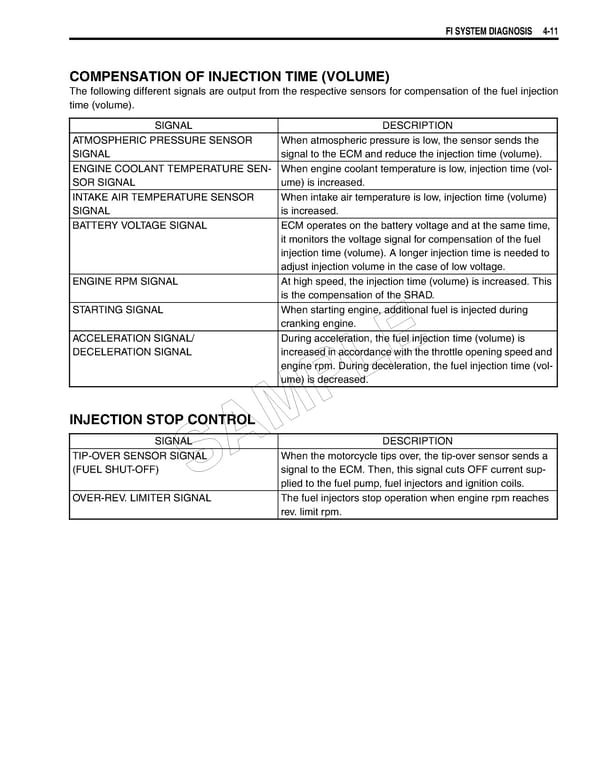
FI SYSTEM DIAGNOSIS 4-11 COMPENSATION OF INJECTION TIME (VOLUME) The following different signals are output from the respective sensors for compensation of the fuel injection time (volume). SIGNAL DESCRIPTION ATMOSPHERIC PRESSURE SENSOR When atmospheric pressure is low, the sensor sends the SIGNAL signal to the ECM and reduce the injection time (volume). ENGINE COOLANT TEMPERATURE SEN- When engine coolant temperature is low, injection time (vol- SOR SIGNAL ume) is increased. INTAKE AIR TEMPERATURE SENSOR When intake air temperature is low, injection time (volume) SIGNAL is increased. BATTERY VOLTAGE SIGNAL ECM operates on the battery voltage and at the same time, it monitors the voltage signal for compensation of the fuel injection time (volume). A longer injection time is needed to adjust injection volume in the case of low voltage. ENGINE RPM SIGNAL At high speed, the injection time (volume) is increased. This is the compensation of the SRAD. STARTING SIGNAL When starting engine, additional fuel is injected during cranking engine. ACCELERATION SIGNAL/ During acceleration, the fuel injection time (volume) is DECELERATION SIGNAL increased in accordance with the throttle opening speed and E engine rpm. During deceleration, the fuel injection time (vol- L ume) is decreased. P INJECTION STOP CONTROL M SIGNAL A DESCRIPTION TIP-OVER SENSOR SIGNAL When the motorcycle tips over, the tip-over sensor sends a (FUEL SHUT-OFF) S signal to the ECM. Then, this signal cuts OFF current sup- plied to the fuel pump, fuel injectors and ignition coils. OVER-REV. LIMITER SIGNAL The fuel injectors stop operation when engine rpm reaches rev. limit rpm.
 Suzuki GSXR 1000 K5 K6 Page 170 Page 172