

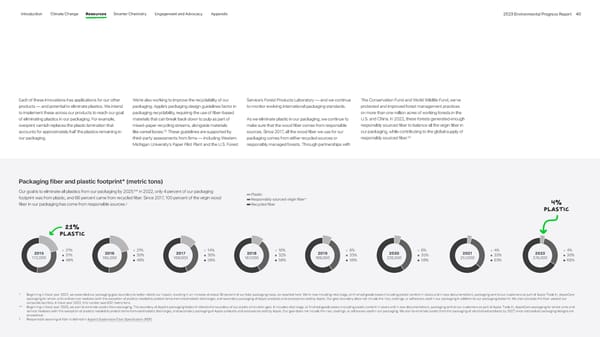
Introduction Climate Change Resources Smarter Chemistry Engagement and Advocacy Appendix 2023 Environmental Progress Report 40 Each of these innovations has applications for our other We’re also working to improve the recyclability of our Service’s Forest Products Laboratory — and we continue The Conservation Fund and World Wildlife Fund, we’ve products — and potential to eliminate plastics. We intend packaging. Apple’s packaging design guidelines factor in to monitor evolving international packaging standards. protected and improved forest management practices to implement these across our products to reach our goal packaging recyclability, requiring the use of fiber-based on more than one million acres of working forests in the of eliminating plastics in our packaging. For example, materials that can break back down to pulp as part of As we eliminate plastic in our packaging, we continue to U.S. and China. In 2022, these forests generated enough overprint varnish replaces the plastic lamination that mixed-paper recycling streams, alongside materials make sure that the wood fiber comes from responsible responsibly sourced fiber to balance all the virgin fiber in accounts for approximately half the plastics remaining in like cereal boxes. 53 These guidelines are supported by sources. Since 2017, all the wood fiber we use for our our packaging, while contributing to the global supply of our packaging. third-party assessments from firms — including Western packaging comes from either recycled sources or responsibly sourced fiber. 54 Michigan University’s Paper Pilot Plant and the U.S. Forest responsibly managed forests. Through partnerships with Packaging fiber and plastic footprint* (metric tons) Our goal is to eliminate all plastics from our packaging by 2025.** In 2022, only 4 percent of our packaging Plastic footprint was from plastic, and 66 percent came from recycled fiber. Since 2017, 100 percent of the virgin wood Responsibly sourced virgin fiber ** fiber in our packaging has come from responsible sources. † Recycled fiber 4% plastic 21% plastic 2015 21% 2016 21% 2017 14% 2018 10% 2019 8% 2020 6% 2021 4% 2022 4% 172,000 31% 165,000 30% 169,000 30% 187,000 32% 189,000 33% 226,000 35% 257,000 33% 276,000 30% 48% 49% 56% 58% 59% 59% 63% 66% * Beginning in fiscal y ear 2022, we expanded our packaging goal boundary to better reflect our impact, resulting in an increase of about 36 percent of our total packaging mass, as reported here. We’re now including retail bags, all finished goods boxes (including plastic content in labels and in-box documentation), packaging sent to our customers as part of Apple Trade In, AppleCare packaging for whole units and service modules (with the exception of plastics needed to protect items from electrostatic discharge), and secondary packaging of Apple products and accessories sold by Apple. Our goal boundary does not include the inks, coatings, or adhesives used in our packaging In addition to our packaging footprint. We also calculate the fiber used at our corporate facilities. In fiscal year 2022, this number was 632 metric tons. ** Beginning in fiscal y ear 2025, we plan to eliminate plastic from packaging. The boundary of Apple’s packaging footprint reflects the boundary of our plastic elimination goal. It includes retail bags, all finished goods boxes (including plastic content in labels and in-box documentation), packaging sent to our customers as part of Apple Trade In, AppleCare packaging for whole units and service modules (with the exception of plastics needed to protect items from electrostatic discharge), and secondary packaging of Apple products and accessories sold by Apple. Our goal does not include the inks, coatings, or adhesives used in our packaging. We plan to eliminate plastic from the packaging of refurbished products by 2027, once old product packaging designs are phased out. † R esponsible sourcing of fiber is defined in Apple’s Sustainable Fiber Specification (PDF) .
 Apple Environmental | Immersive Page 39 Page 41